Translate a price without mistaking it for certainty
**Level:** Beginner (Foundations) · **Reading time:** 8 min · Allow additional time for the exercises.
A price can be converted into a percentage, but that percentage is not automatically the true chance of a sporting outcome. This distinction is the foundation of the lesson. You will learn what the calculation tells you, what it leaves out and why the probabilities printed into a market can add up to more than 100 percent.
You should be comfortable with decimal odds from Lesson 3. A calculator is useful for the exercises. The teams and prices are imaginary, and no calculation in this lesson establishes that a real bet is profitable.
## Learning objectives
By the end of the lesson, you should be able to:
- Convert decimal odds into implied probability. - Describe a break-even win rate under simple assumptions. - Calculate overround from a complete two-way or three-way market. - Explain why normalizing prices does not reveal verified true chances. - Distinguish uncertainty about one outcome from an average over many hypothetical outcomes.
## 1. Start with probability
Probability describes how likely an event is within a stated model or set of assumptions. It ranges from zero to one, or from zero to 100 percent. A probability of 25 percent means one quarter of the probability total, not a promise that every group of four attempts contains exactly one success.
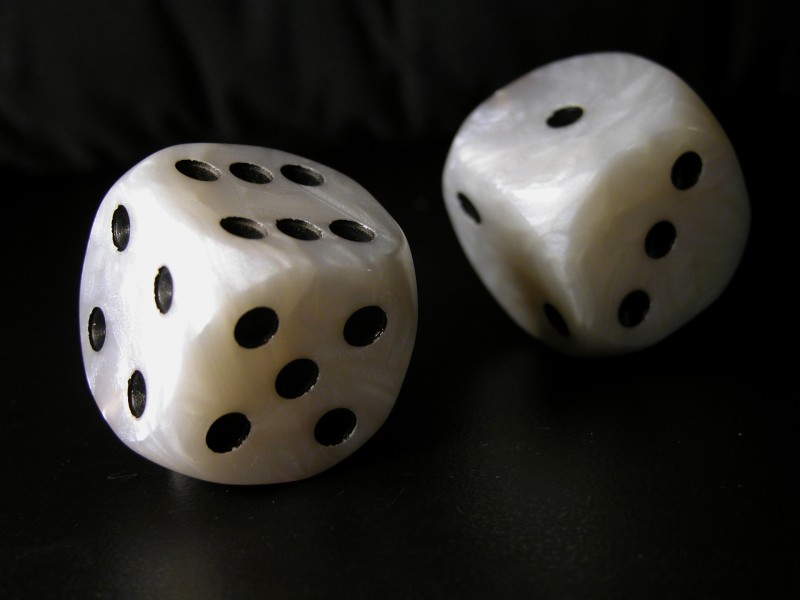
For a fair six-sided die, one specified face has a one-in-six probability because the model assumes six equally likely faces. The six probabilities add to 100 percent. A sporting contest does not become a 50–50 event merely because it has two teams. Two possible outcomes need not be equally likely.
If a basketball winner market includes overtime and has exactly two outcomes, their actual probabilities must add to 100 percent. In a football three-way market, home win, draw and away win together cover the possible results for the stated period. A complete market must include all the mutually exclusive outcomes that its definition allows.
## 2. Convert odds into implied probability
For decimal odds:
**Implied probability = 100 ÷ decimal odds**
At 2.50, divide 100 by 2.50 to obtain 40 percent. At 1.25, the answer is 80 percent. At 4.00, it is 25 percent. These figures translate the offered payout ratios into percentages.
| Decimal odds | Calculation | Implied probability | | ---: | --- | ---: | | 1.25 | 100 ÷ 1.25 | 80% | | 1.50 | 100 ÷ 1.50 | 66.67% | | 2.00 | 100 ÷ 2.00 | 50% | | 2.50 | 100 ÷ 2.50 | 40% | | 4.00 | 100 ÷ 4.00 | 25% |
Keep enough decimal places while calculating and round at the end. Small rounding differences can make totals look slightly different without changing the principle.
### The break-even interpretation
For an ordinary bet with only a win or a loss, no fees and a fixed price, the implied probability is also its break-even win rate. Imagine ten equal PHP 100 bets at 2.50. Four wins return PHP 1,000 in total and six losses return zero. Against PHP 1,000 staked, that particular sequence breaks even.
This is a demonstration of the arithmetic, not a forecast of the next ten results. Real prices vary, outcomes need not be independent, and ten observations are too few to establish a reliable long-term rate. Pushes, commissions and other conditions can require a different calculation.
## 3. Calculate overround in a two-way market
Suppose an imaginary market prices Team A at 1.90 and Team B at 1.90. Assume exactly one of the two selections wins.
Each quoted price implies about 52.63 percent. Adding them produces 105.26 percent. The amount above 100 percent is **5.26 percentage points of overround**.
**Overround = sum of all quoted implied probabilities − 100%**
The actual chances cannot both be 52.63 percent when there are only two mutually exclusive outcomes. The excess shows that the set of prices does not form a probability total of 100 percent. It is a way of describing the pricing margin built into the market.
Do not confuse overround with a guaranteed profit on that event. A bookmaker's realized result depends on what happens and where the stakes were placed. A bettor's realized loss can also be very different from a quoted percentage.
## 4. Repeat the calculation for three outcomes
Consider a fictional football market with the following prices:
| Outcome | Decimal odds | Implied probability | | --- | ---: | ---: | | Home win | 2.00 | 50.00% | | Draw | 3.50 | 28.57% | | Away win | 4.00 | 25.00% | | Total | — | 103.57% |
The quoted overround is approximately 3.57 percentage points. Leaving out the draw would produce an incomplete and misleading total. All prices must also come from the same market definition and observation point for this example to make sense.
An odds screenshot from one provider in the morning and a second screenshot from another provider at night do not describe one bookmaker's market at a single moment. A precise calculation begins with consistent inputs, not just a correct formula.
## 5. Understand normalization and its limits
A simple normalization divides each quoted probability by their total. In the two-way 1.90 example, dividing 52.63 by 105.26 produces 0.50 for each team. The normalized percentages are 50 percent and 50 percent.
For the three-way example, the normalized values are approximately 48.28 percent for the home win, 27.59 percent for the draw and 24.14 percent for the away win. Minor rounding can leave the displayed total just above or below 100 percent.
Normalization removes the excess proportionally. It does not reveal team news, evaluate a lineup or demonstrate that the margin was distributed proportionally in the first place. It is one mathematical adjustment, not a verified assessment of true probabilities.
Research by University College Dublin economists Tadgh Hegarty and Karl Whelan explains why the relationship between quoted overround and expected loss depends on assumptions about pricing across outcomes. For a beginner, the useful conclusion is that one market percentage should not be presented as every bettor's exact expected loss.
## 6. Separate an expected result from a guaranteed result
An expected value is an average within a probability model. It is not the amount that must be won or lost on one bet. To calculate it, you need a probability assumption as well as the price.
Suppose a hypothetical selection genuinely has a 50 percent chance, pays decimal 1.90 and has a PHP 100 stake. A win produces PHP 90 profit and a loss costs PHP 100. Its expected net result is:
**0.50 × PHP 90 + 0.50 × (−PHP 100) = −PHP 5**
An individual settled bet in this model produces either a PHP 90 profit or a PHP 100 loss, not a PHP 5 loss. The minus PHP 5 is an average across the model's possible outcomes. It is also different from the 5.26-point overround quoted earlier.
The 50 percent chance in this example was supplied as an assumption. In a real match, estimating that probability is a separate and uncertain task. Writing a number into a formula does not validate the number.
## 7. Watch for three reasoning errors
### Treating a favourite as certain
A short price usually implies a relatively high probability within the quoted market. It still leaves room for the selection to lose. Odds of 1.25 imply 80 percent, which is not 100 percent.
### Treating a streak as proof
A few consecutive wins do not establish that a method has identified the true chances. A few losses do not mean a win is owed. Changes in opponents, conditions, prices and sample size all matter when interpreting sports results.
### Multiplying dependent probabilities
For two genuinely independent events with 50 percent probabilities, both occurring has a 25 percent probability. But a team's win and its leading scorer's high points total may be related. Without independence, multiplying two standalone probabilities can give a misleading answer. Lesson 5 returns to this issue when discussing parlays.
## Practice questions
1. What probability is implied by decimal 3.20? 2. A two-way market lists both outcomes at 1.80. What is its approximate overround? 3. Why must the draw be included when calculating a football three-way market? 4. Does proportional normalization establish the actual chance of a team winning? 5. At odds of 2.00, a hypothetical selection has a true 40 percent chance and a PHP 100 stake. What is the expected net result?
### Answer key
1. **31.25 percent**, because 100 ÷ 3.20 = 31.25. 2. Each implies about 55.56 percent. The total is about 111.11 percent, giving **11.11 percentage points of overround** when calculated before rounding. 3. It is one of the mutually exclusive outcomes. Excluding it leaves the market incomplete. 4. **No.** It adjusts the quoted percentages without independently verifying sporting probabilities. 5. A win gives PHP 100 profit and a loss costs PHP 100. Calculate 0.40 × 100 + 0.60 × (−100) = **−PHP 20**. That is the model's expected result, not a guaranteed single-bet loss.
## Lesson recap
Implied probability translates a price. Overround describes the excess in a complete set of quoted probabilities. Neither removes uncertainty or proves a real-world advantage. Keep assumptions visible and separate arithmetic from evidence about a sporting event.
## Continue the foundation course
[Lesson 1 – Setting Betting Budgets and Avoiding Chasing Losses](https://betting.crazywingo.ph/article/betting-budget-limits-avoid-chasing-losses)
[Lesson 2 – Sports Betting Basics for Complete Beginners](https://betting.crazywingo.ph/article/sports-betting-basics-for-beginners)
[Lesson 3 – How to Read Betting Odds and Calculate Payouts](https://betting.crazywingo.ph/article/read-betting-odds-calculate-payouts)
**Lesson 4 – Implied Probability and Bookmaker Margins Explained — current lesson**
[Lesson 5 – Moneylines, Spreads, Totals and Parlays for Beginners](https://betting.crazywingo.ph/article/moneyline-spread-total-parlay-beginners)
*Image credit: Gary Curtis (Gaz). Representative dice image, unmodified, 800 × 600 pixels. [Wikimedia Commons source](https://commons.wikimedia.org/wiki/File:Dice.jpg) · [CC BY-SA 3.0](https://creativecommons.org/licenses/by-sa/3.0/).*